
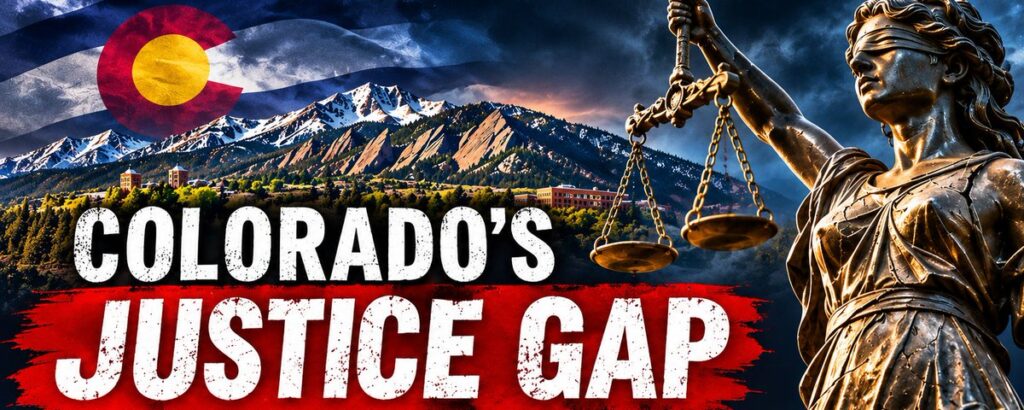
COLORADO’S JUSTICE GAP: WHAT HAPPENS WHEN AUTHORITIES REFUSE TO INVESTIGATE A PATTERN OF HARASSMENT?

A Boulder County resident died by suicide after years of alleged coordinated cyberstalking, litigation, and financial devastation. After his death, I tried to provide investigators with evidence that I believe documents the campaign against him. In my experience, they refused to examine it seriously. The same online campaign continues today, raising a larger question: How many other Colorado residents and businesses have fallen into the gap between law enforcement and the civil courts?
By Corey Goode
My friend and business associate David Wilcock lived in Nederland, Colorado, in Boulder County. Millions of people knew him from his appearances on Ancient Aliens and other television programs, but he was also a Colorado resident, taxpayer, and businessman. Among his other business interests, David served as a shareholder and board member of Stavatti Aerospace.
For years, David and I maintained that a sustained campaign of cyberstalking, online harassment, threats, reputational attacks, and business interference was targeting us, our reputations, and several of our business interests. David maintained that people associated with Stavatti Aerospace were also targeted. The company subsequently experienced serious financial difficulties and litigation, including litigation involving New Jersey. People associated with Stavatti maintain that harassment surrounding the company continues today, just as the online harassment targeting me and businesses associated with me continues.
What makes this situation particularly frustrating is that much of the material I believe warrants investigation is not hidden. Years of videos, livestreams, social-media posts, comments, recurring participants, cross-references, and accounts amplifying one another remain publicly available. In my opinion, an experienced cybercrime detective could spend half an hour reviewing a representative portion of this public material and identify enough apparent coordination, recurring participants and cross-jurisdictional activity to justify a serious investigation.
That does not mean a detective could establish criminal guilt in 30 minutes. An investigation exists precisely to determine whether apparent coordination is actually criminal, who participated, what their intent was, and what laws may have been violated. My complaint is simpler: I believe authorities have repeatedly refused to seriously examine the evidence needed to answer those questions.
DAVID’S DEATH SHOULD HAVE RESULTED IN A CLOSER LOOK
David died by suicide on April 20, 2026. By then, he had endured years of litigation, substantial financial pressure, attacks on his reputation and business interests, and severe problems in his personal life and marriage.
Based upon what I personally witnessed and the communications and evidence available to me, I believe the cumulative pressure of the alleged harassment, litigation, financial losses, damage to his business interests, and deterioration of his personal life contributed substantially to the circumstances culminating in his suicide. I want to be precise: this is my conclusion based on my experience with David. It is not a judicial finding, nor has law enforcement established that another person was criminally responsible for his death.
That distinction is part of the problem I am raising.
After David died, I wanted investigators to examine whether the years of alleged coordinated harassment he had experienced were relevant to the circumstances surrounding his death. I had names, timelines, witnesses, online material, and information concerning people whom I believed had coordinated their activities across different platforms and jurisdictions.
I wanted to provide that evidence to the detective investigating David’s death. In my experience, the Boulder County Sheriff’s Office prevented me from gaining meaningful access to that detective and declined to seriously examine the larger body of evidence I was trying to provide about the alleged coordinated harassment.
I was not asking the Sheriff’s Office to accept my conclusions. I was not asking deputies to arrest anyone based on my word. I wanted investigators to examine the evidence, preserve relevant online material, map the accounts and recurring participants, interview witnesses, determine whether the people involved acted independently or coordinated with one another, and establish which conduct occurred in Boulder County and which crossed into other jurisdictions.
If a legitimate investigation concluded that no prosecutable crime occurred, authorities could document and defend that conclusion. What troubles me is the question of how authorities can determine whether sustained harassment had any relationship to the circumstances surrounding a Colorado resident’s death when evidence offered by people close to that resident is not meaningfully examined.
THE CIVIL COURTS DID NOT SOLVE THE PROBLEM
Before David’s death, we also attempted to use the civil justice system. A federal lawsuit included claims against an individual whom we alleged played a leading role in the campaign against us. The relevant claims ultimately failed to provide the relief we sought and were dismissed with prejudice.
From my perspective, the dismissal did not end the online campaign. Instead, it appeared to embolden some of the people involved, and the attacks intensified. Our businesses suffered, legal expenses accumulated, and the underlying conduct we had complained about continued.
This experience exposed what I believe is a serious gap between Colorado’s criminal and civil justice systems. A resident can report stalking, threats, cyberstalking, or a complicated pattern of harassment and be told that the situation is a civil matter. The person then hires attorneys, sometimes at hundreds of dollars per hour, and enters litigation that can continue for years. Legal expenses can reach tens or hundreds of thousands of dollars while the conduct that originally brought the person to law enforcement continues.
If the civil litigation fails to stop the conduct, the victim can return to law enforcement only to encounter the same jurisdictional and evidentiary problems that existed before. By then, the situation may involve years of online activity, multiple people, several lawsuits, different social-media platforms, and conduct occurring across cities, counties, or states.
The result can become a vicious circle in which the criminal justice system points toward the civil courts, the civil courts move slowly and at enormous expense, and nobody assumes responsibility for examining the entire pattern.
For an ordinary Colorado family or small business, that can be financially devastating.
HOW DOES A MODERN HARASSMENT CAMPAIGN FIT INTO A SYSTEM BUILT AROUND INDIVIDUAL INCIDENTS?
One problem I believe Colorado needs to examine is the difference between an individual incident and a coordinated course of conduct.
Modern harassment doesn’t necessarily involve one person standing outside someone’s house every night. It can involve multiple individuals and anonymous accounts operating across YouTube, X, podcasts, livestreams, websites, email, and other platforms. Different people may contribute different parts of the activity, while no single incident appears serious enough on its own to explain what the victim says is happening.
Threats, unwanted communications, impersonation, doxxing, monitoring, repeated targeting, contact with employers or business partners, interference with commercial relationships, and efforts to encourage larger online audiences to target the same person may occur.
When investigators evaluate each incident separately, they may see a collection of internet disputes. When investigators place several years of conduct on a single timeline, however, a very different picture may emerge.
That is why I believe the central question is whether Colorado’s laws and investigative procedures can recognize and investigate a coordinated course of conduct, rather than treating every incident as unrelated.
THIS MAY BE LARGER THAN WHAT HAPPENED TO DAVID AND ME
Since dealing with these issues, I have spoken with other Boulder-area residents and business owners who have described their own frustrations with law enforcement and the courts. Some have described difficulty obtaining reports. Others say they were directed toward civil remedies, spent substantial amounts of money on attorneys, and still did not obtain meaningful relief.
Those conversations do not establish systemic corruption, and I do not want to make that leap without evidence. They do, however, raise a legitimate question: How many Colorado residents have experienced some version of the same institutional gap?
That is something I want to document, not speculate about.
If dozens of unrelated Colorado residents can produce police correspondence, court records, prosecutorial communications, and other evidence showing similar patterns, policymakers should examine it. If the evidence shows these are isolated situations rather than a systemic problem, that is also important to establish.
COLORADO’S JUSTICE SYSTEM IS NOT BEYOND SCRUTINY
These questions arise against the backdrop of Colorado’s own recent judicial accountability problems. The Colorado Judicial Branch endured a major scandal involving a multimillion-dollar contract that resulted in investigations, legislative scrutiny, and unprecedented public discipline of a former Colorado Supreme Court chief justice. Colorado voters subsequently approved Amendment H, restructuring important parts of the state’s judicial-discipline process.
The Colorado Commission on Judicial Discipline later reported receiving 473 complaints involving judges during 2025, approximately 29 percent more than the previous year and the highest number in at least a decade. Most of those complaints did not proceed beyond initial screening, and a complaint is not proof that a judge committed misconduct.
The larger lesson is that institutions charged with administering justice must themselves remain subject to scrutiny, transparency, and reform. Accountability should not be interpreted as hostility toward the justice system. Proper accountability should strengthen public confidence in it.
WHY MY BACKGROUND MATTERS TO THIS STORY
My name is Corey Goode. Today, I am CEO of Disclosure Media, Inc., an entertainment company whose properties include Disclosure Comics and our streaming and social-media platform, Ascension Works TV (AWTV). We develop films, television programs, documentaries, books, graphic novels, comics and video games, including entertainment dealing with UFOs, aliens, paranormal phenomena, ghosts, Bigfoot and science fiction.
That is the part of my career most people now know, but it represents only roughly the last decade of my professional life.
Before entering the entertainment industry, I spent more than 20 years working in Information Technology, much of it in banking and financial services. I was repeatedly placed in positions of trust involving critical computer systems, networks, and sensitive environments, including work involving the Federal Reserve Bank of Dallas.
From 2007 through 2013, I also served in the Texas State Guard, where I worked in command, control, communications, computers, and intelligence (C4I). My duties included communications support during emergency and disaster responses, including hurricanes. Through that service and MEMS and NIMS/FEMA-related training and activities, I spent considerable time around police officers, Sheriff’s personnel, emergency-management officials, and state and federal law enforcement.
I developed friendships with law-enforcement officers. I attended happy hours and family cookouts with them. I saw the sacrifices officers and their families make, and I continue to have deep respect for the profession.
That is one reason my experiences in Colorado have been so difficult to reconcile with my previous experiences.
During interactions with police, Sheriff’s personnel, and judges, I have been told, in substance, that producing entertainment about aliens, UFOs, ghosts, and controversial subjects naturally attracts hostile attention, and that I should regard this as part of the cost of choosing this line of business.
I fundamentally disagree.
A public figure does not consent to being stalked because he appears on television. A filmmaker does not consent to threats because he makes documentaries about UFOs. A comic-book publisher does not consent to cyberstalking because its stories involve aliens. A business owner’s family does not become fair game because people dislike the company’s subject matter.
I sometimes feel that more than 20 years in IT, banking, and trusted technical positions disappear from consideration because the last decade of my career involved unconventional entertainment. But even that misses the larger principle. My professional résumé should not determine whether credible evidence of criminal conduct is investigated in the first place.
The same protection should apply to the banker, construction worker, grocery clerk, filmmaker, Christian, atheist, Republican, Democrat, and person whose beliefs everyone else thinks are ridiculous.
That is the point of equal protection under the law.
THIS IS ALSO A COLORADO BUSINESS ISSUE
Boulder and much of Colorado are expensive places to live and operate a business. Housing, commercial real estate, taxes, payroll, insurance, and other operating expenses are substantial, while many businesses are still dealing with long-term consequences from the economic disruptions of the COVID era.
Colorado businesses should not also need six-figure legal reserves simply to defend themselves from complicated patterns of alleged harassment or interference.
At some point entrepreneurs begin asking whether Colorado remains the best place to build and expand their companies. Families begin asking whether it remains the best place to raise their children. State and local leaders should take those questions seriously because public safety, reliable courts and confidence in law enforcement are part of a state’s business environment.
DISCLOSURE MEDIA IS NOW INVESTIGATING THE LARGER QUESTION
Disclosure Media is developing a True Crime television project examining the gaps between Colorado’s criminal and civil justice systems, beginning with Boulder County.
I do not want this project to consist of angry people making accusations on camera. We are looking for documented cases supported by police reports, court records, emails, letters, protective-order applications, prosecutorial correspondence, recordings, witnesses, case numbers, and contemporaneous documentation.
We also want to hear from people inside the system. Police officers, Sheriff’s deputies, detectives, prosecutors, attorneys, former judges, court employees, victims’ advocates and whistleblowers may understand institutional problems that citizens on the outside cannot see.
If inadequate staffing, outdated statutes, jurisdictional limitations, or evidentiary rules prevent investigators from pursuing complicated coordinated-harassment cases, legislators need to understand those limitations. Reform should give good officers better tools rather than simply blame them for problems they may not have the authority or resources to solve.
A REQUEST TO FEDERAL LAW ENFORCEMENT
I am also publicly asking the United States Attorney’s Office for the District of Colorado and the FBI Denver Field Office, including the Loveland Resident Agency responsible for Boulder County, to examine documented complaints involving potential coordinated and cross-jurisdictional criminal activity when federal jurisdiction may exist.
I am not asking federal authorities to assume that my allegations are correct. I am asking them to examine the evidence and independently determine what occurred.
When alleged conduct involves electronic communications, multiple jurisdictions, interstate activity, or other circumstances that may implicate federal law, federal authorities may be better positioned to see a pattern that individual local agencies cannot.
If the evidence does not establish a federal crime, then that conclusion should follow the investigation. Citizens should not encounter a system in which every agency assumes somebody else should be responsible for looking.
COLORADO RESIDENTS AND BUSINESS OWNERS: HELP US DETERMINE HOW WIDESPREAD THIS IS
If you are a Colorado resident or business owner who has experienced something similar, I want to hear from you. Our investigation begins with Boulder County, but we are interested in documented experiences from throughout Colorado.
Please tell us what happened, which agencies or courts were involved, whether you obtained a police or incident report, whether you were directed toward civil litigation, what happened in court, whether the underlying conduct continued, and what documentation you can provide. If you would consider participating in our True Crime project, please let us know.
You can contact us at [email protected].
I also ask Colorado residents and business owners to circulate this article. Send it to attorneys, business owners, victims’ advocates, journalists, current and former law-enforcement officers, and people who have dealt with Colorado’s courts.
If you want to become involved as an activist for responsible legal reform in Colorado, contact us. The goal should not be to create another angry online movement. The goal should be to bring documented experiences together with attorneys, legislators, investigators, and policy experts who can turn legitimate problems into workable reforms.
COLORADO SHOULD CONSIDER A COORDINATED STALKING LAW
Ultimately, I do not believe another television program, another lawsuit or another round of complaints will be enough.
I want Colorado lawmakers, attorneys, prosecutors, constitutional lawyers, law-enforcement professionals and victims’ advocates to examine the creation of legislation specifically addressing coordinated stalking and harassment.
Some victims use the term “gangstalking.” Whatever terminology lawmakers ultimately choose, the legislation should focus on objectively identifiable conduct and evidence, not labels.
A Colorado Coordinated Stalking Act could establish mandatory documentation for qualifying complaints so citizens receive an incident or complaint number and a permanent record exists. It could establish defined investigative procedures when objective statutory thresholds are met and provide mechanisms for aggregating incidents across time, platforms, and jurisdictions so investigators can evaluate an alleged course of conduct rather than viewing each event in isolation.
The law could also establish procedures for cross-jurisdictional coordination, supervisory review when qualifying complaints are declined, and expedited judicial consideration of protection-order requests when documented evidence indicates an ongoing safety threat. Prosecutors receiving qualifying referrals could be required to evaluate the full alleged course of conduct and document the referral’s disposition.
Any legislation must simultaneously contain strong due-process protections. Nobody should be arrested because another person simply says, “I am being gangstalked.” An allegation is not evidence, and an investigation is not a conviction.
The objective should instead be to establish clear thresholds at which credible, documented evidence triggers a defined process for review and investigation. That approach protects legitimate victims while protecting innocent people from unsupported or malicious accusations.
AN OPEN REQUEST TO COLORADO’S LEADERS
I am asking Colorado legislators, local representatives, and attorneys to work with us on this proposal. I want law-enforcement leaders to explain what investigative tools they need, prosecutors to identify deficiencies in existing statutes, civil attorneys to explain why victims can spend years and hundreds of thousands of dollars without stopping continuing conduct, and constitutional attorneys to ensure that any legislation protects due process.
I am also asking Governor Jared Polis and whoever Colorado voters choose to serve as the state’s next governor to make closing gaps in Colorado’s criminal and civil justice systems a priority for the next administration.
Colorado needs a legal environment in which legitimate complaints receive meaningful consideration, police officers have appropriate investigative tools, courts retain public confidence, and businesses believe they can safely invest and operate here. That is particularly important for businesses still dealing with the long-term economic consequences of the COVID era.
This should not become another partisan fight. Public safety, due process, judicial integrity, effective policing, and a stable business environment are not Republican or Democratic principles. They are basic functions of government.
David Wilcock can no longer participate in this conversation. Other Colorado families can, and so can business owners, police officers, attorneys, prosecutors, legislators and judges who believe the system can be improved.
If you have a documented experience that should be part of this investigation, or if you are an attorney, legislator, law-enforcement professional, victims’ advocate, or Colorado resident interested in helping develop responsible reforms, contact [email protected].
Please circulate this article and preserve your documentation. We need to determine whether the experiences described here are isolated failures or evidence of a larger structural problem. If a gap in Colorado law allows legitimate victims to spend years moving between police departments, Sheriff’s offices, prosecutors, and civil courts without meaningful protection, then our responsibility is to identify it carefully, document it honestly, and fix it.
Colorado residents, families, law-enforcement officers and businesses all deserve a justice system worthy of their confidence.
#Colorado #Boulder #BoulderCounty #Nederland #ColoradoPolitics #ColoradoLegislature #ColoradoCourts #ColoradoSupremeCourt #JusticeReform #JudicialReform #LawEnforcementReform #Cyberstalking #Stalking #VictimsRights #PublicSafety #TrueCrime #ColoradoBusiness #SmallBusiness #CivilRights #DisclosureMedia #DisclosureComics #AscensionWorksTV #FBIDenver
LikeRecommend0 recommendationsPublished in Activism, Community




Responses