
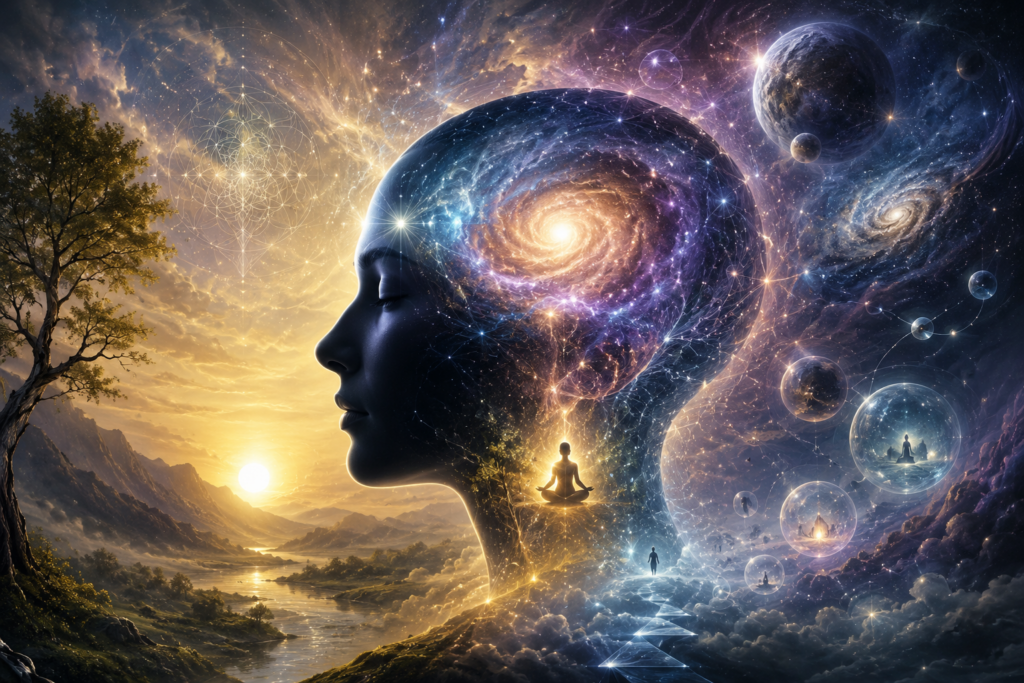
The Nature Of Consciousness

What does it mean to have consciousness? Consciousness itself is not the same as being self aware. When an organism reaches a certain point in its evolution, something happens and its mind begins to turn inwards. At this stage it becomes aware of its own thoughts and starts to see itself as a separate entity. This could have occurred around the time when the human species began using sounds to name objects and each other. Most scientists believe that modern human language capacity emerged between 150000 and 200000 years ago, which is around the time Homo Sapiens appeared in Africa.
That being said, my opinion is that this emergence of self identity is not identical to consciousness in the metaphysical sense. Consciousness does not merely refer to a creature which is conscious of itself and the world around it. Without consciousness we wouldn’t know what it’s like to be anything, because there wouldn’t be any subjective experience at all. There’s a helpful thought experiment you can use to get a better grasp of the idea. Imagine what it would be like to be a bat. Now bats are blind creatures that rely mainly on echolocation to navigate and hunt in total darkness. Echolocation works by emitting high frequency sound pulses which bounce or echo against the shapes in the area and return. This enables the bat to avoid bumping into walls while it’s flying.
It’s pointless to attempt to comprehend what that’s like because we are not equipped with the same sensory organs with which to compare experiences. We could get a closer approximation if we had to imagine the sensory experiences of another human, but even that is nuanced and greatly varied. It is not necessary to be intelligent, or to be able to feel pleasure or pain, or even to be human to have consciousness. Consciousness is pure awareness of yourself and the world around you. We have several types of senses that we use to gather information about the world around us. We also have an ability to control our attention and keep it fixed on internal stimuli.
My experience in meditation practice has given me some insight into the nature of consciousness. When you meditate, it is important to avoid analyzing your thoughts and feelings. Meditation is different from contemplation. The goal is to focus your attention on the sensations that you feel while letting your thoughts pass. Listen carefully to any sounds that you hear without thinking too much about them. Look at the scene in front of you and try not to analyze the meaning of it. See it simply as colors with shades of light and dark. Feel your body as a cloud of sensations without ascribing meaning to it. When you tune into the basic level of what is, you’re getting closer to consciousness.
To reinforce the mental illustration I’m trying to make, you could try the following meditation exercise. Close your eyes as you sit upright. Breathe deeply as you focus your attention on your hands. Place your hands on top of your knees and just feel the texture of the clothing you’re wearing. The only thing your attention should be on is feeling your hands. Is it rough or smooth? Keep it there for a minute and realize that as consciousness.
We add labels to these feelings and sensations so that we can communicate them to others, but the labels themselves don’t carry all the information that describes what those qualia are. To know what they are one needs to be a human and experience the sensations as a human. To know what it’s like to be a bat, one needs to be a bat. It was philosopher Thomas Nagel who in 1974 suggested that “an organism is conscious if there is something that there is like to be that organism.” Consciousness boils down to experience and intuition. Traits we often associate with consciousness aren’t exclusive to human behavior. Consciousness is not identical to the decisions we make, and should be viewed as separate from our sense of self.
I believe there are ascending levels of consciousness. The consciousness of a mouse is of a lower order than the consciousness of a dog for example. Human beings obviously wield the highest level of consciousness among the creatures of Earth. Within the human experience there are also varying levels of consciousness.
When humans begin to evolve to a higher state, the difference lies predominantly in the brain. We become conscious of higher emotions such as compassion, love, and joy. They cease to be words on a page and actually come alive, and impact every action we take in life. These kinds of people meditate on higher states of consciousness as opposed to simple sensory inputs.
The hard problem of consciousness deals with determining how subjective experiences could arise out of chemical brain processes. This has been studied extensively but a solution has yet to be found. Consciousness involves being aware of your surroundings and your internal mental states. It allows you to perceive your external world by interpreting sensory information. Consciousness also includes the awareness of the wide range of emotions that we experience.
The problem is that even though we understand the complex neural activities of the brain, they do not explain the subjective experiences of consciousness.
The approach of Panpsychism resonates most with me. It proposes that consciousness is fundamental and that it is a ubiquitous feature of the physical world. It may even be possible for simple matter to have some form of subjective experience.
LikeRecommend0 recommendationsPublished in Awakening & Ascension, Metaphysics, Uncategorized






Responses